
About the area: the history of Newbridge and Ratho Station
Located on the western fringe of Edinburgh, the neighboring towns of Newbridge and Ratho Station serve as modern transport hubs. However, beneath the motorways and industrial estates lies a history spanning over 6,000 years, from Iron Age chariots to the birth of the Scottish railway system.
Ancient Origins: Prehistoric Landscapes
The area around Newbridge and Ratho Station has been a site of continuous human occupation since at least the Mesolithic period (c. 6640–6230 BC).
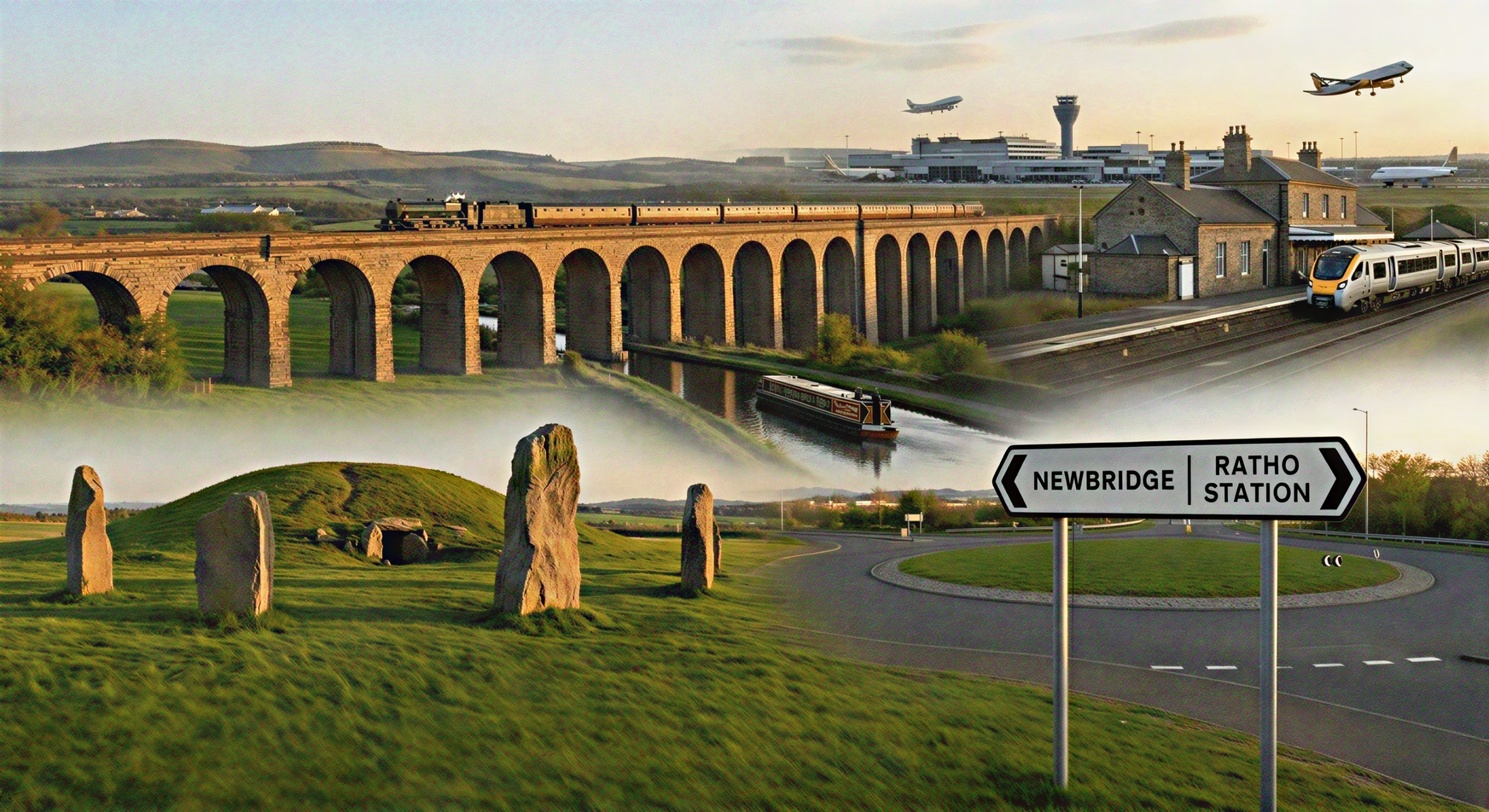
- Huly Hill and the Standing Stones: Dominating the eastern side of Newbridge is Huly Hill, a prehistoric burial mound (tumulus) dating to the early 2nd millennium BC. It is surrounded by three large standing stones that likely formed part of an earlier Neolithic stone circle. Another standing stone is found diagonally opposite the hill, on the other side of the roundabout. It sits nestled within the grounds of the last building before the roundabout, found to the left when travelling westbound on the A8.
- The Newbridge Chariot: In 2001, during excavations for the Edinburgh Interchange, archaeologists discovered the remains of an Iron Age chariot burial (c. 250 BC). This was the first discovery of its kind in Scotland and indicated direct cultural links between the Lothians and Continental Europe.
- Ratho Station Standing Stone: Similar prehistoric evidence exists in Ratho Station, where a nationally important standing stone from the early 2nd millennium BC marks the ancient landscape.
The Roman and Medieval Eras
Newbridge’s location as a natural crossing point over the River Almond made it strategically important for centuries.
- Roman Infrastructure: Evidence of Dere Street, a major Roman road, has been identified in the area. In 1699, a 2nd-century AD Roman milestone was discovered nearby at Ingliston, and a carved Roman eagle fragment remains built into the gable of a local farmstead at West Ingliston.
- Medieval Farming: Archaeological surveys have revealed that the land was actively farmed throughout the 11th to 14th centuries, with small settlements and field systems predating the modern towns.
Industrial Evolution: Canals and Quarries
The 19th century transformed the rural landscape of Ratho Station into an industrial powerhouse.
- The Union Canal (1822): The arrival of the Union Canal provided a direct link for transporting goods to Edinburgh. Ratho Quarry (now the Edinburgh International Climbing Arena) became a major source of “whinstone” (quartz dolerite). This hard-wearing stone was used for the setts and kerbstones that paved the streets of Edinburgh’s New Town.
- The Newbridge Inn: Reflecting its history as a transit point, the Newbridge Inn was founded in 1683. While the current building dates to 1895, it sits on the site of one of the region’s oldest coaching inns, serving travelers on the original road between Edinburgh and Glasgow.
The Railway Age and the Birth of “Ratho Station”
While Newbridge is named after the bridge over the River Almond, Ratho Station owes its name and existence to the steam engine.
- The Edinburgh and Glasgow Railway (1842): On December 18, 1842, the Edinburgh and Glasgow Railway opened its main line. Ratho Railway Station was built to serve the village of Ratho (located 1.5 miles to the south). Eventually, a new village grew around the station itself, taking the name “Ratho Station.”
- The Almond Valley Viaduct: To the west of the towns stands “The Arches,” a massive 36-arch stone viaduct designed by John Miller. Completed in 1842, it remains one of the most significant engineering landmarks in Scotland, carrying the main railway line 18 meters above the River Almond.
Modern Development
In the 20th century, the two towns became synonymous with Scotland’s road network. The Newbridge Roundabout was constructed in 1970 to manage the intersection of the M8 and M9 motorways. In 1975, both towns were officially incorporated into the City of Edinburgh.